
Reading time:6 min read
The Benefits of Ghusl (Ritual Bathing) in Islam
Tohir Najmudeen
August 22, 2025In the name of Allah, the Most Beneficent, the Most Merciful. May His peace and blessings be upon the noble Prophet Muhammad (peace be upon him), his family, his companions, and all those who follow his way until the Day of Judgment.
Allah the Almighty states in the Holy Quran: "And if you are in a state of janabah (major impurity), then purify yourselves (by ghusl)." — Surah Al-Ma’idah (5:6)
"Indeed, Allah loves those who are constantly repentant and loves those who purify themselves." — Surah Al-Baqarah (2:222)
The Prophet Muhammad (peace be upon him) said: “It is obligatory for every adult Muslim to perform Ghusl on Fridays, use a toothbrush (miswak), and wear perfume if available.” — Sahih al-Bukhari, Hadith 880
“The angels do not come near a person who is junub (in a state requiring Ghusl) until he performs Ghusl.” — Sunan Abu Dawood, Hadith 227
Ghusl is the Arabic word for a complete ritual bath or body purification. It is performed after major impurity, menstruation, childbirth, and also before Jumu'ah (Friday) and Eid prayers, among other occasions. It is an act of both physical and spiritual purification.
Ghusl differs from Wudu in that Wudu cleanses specific body parts for minor impurities, while Ghusl purifies the entire body from major impurities. Once Ghusl is performed, it generally suffices for Wudu as well, meaning you don't need to perform Wudu again unless you break your Wudu.
How Ghusl is Performed
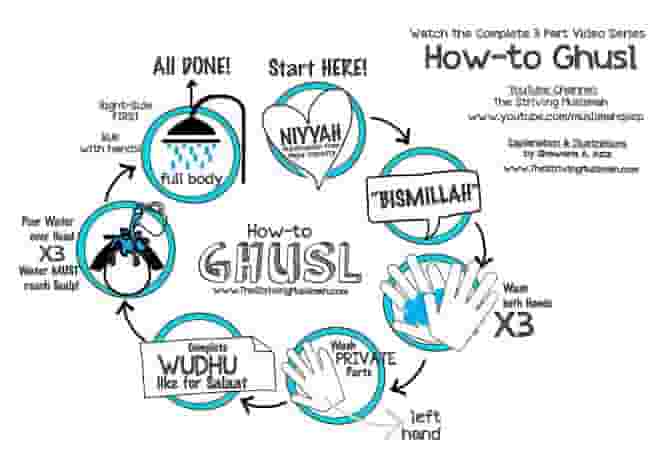
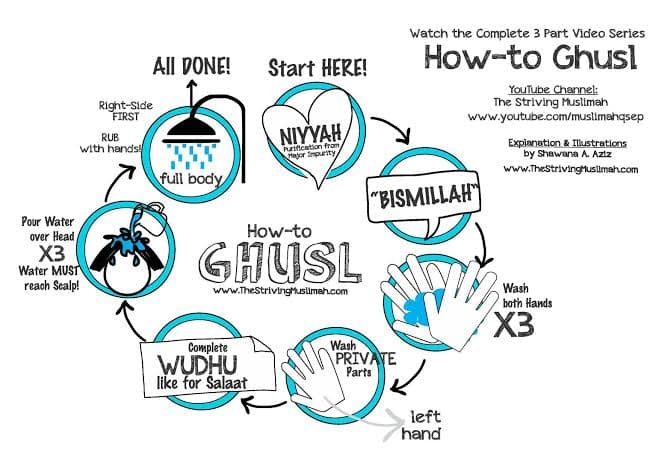
1. Make Intention (Niyyah): Have the intention in your heart to perform Ghusl for purification. This intention is crucial for the validity of the Ghusl.
2. Wash Your Hands: Wash your hands three times.
3. Wash Private Parts: Cleanse your private parts thoroughly. It is also recommended for men to urinate before Ghusl after ejaculation to ensure any remaining seminal fluid is expelled.
4. Perform Wudu (Ablution): Perform a complete Wudu, as you would for prayer.
5. Wash Your Head: Pour water over your head three times, ensuring it reaches the roots of your hair and scalp. If a woman has braided hair, she does not need to undo her braids unless water cannot reach her scalp.
6. Wash the Entire Body: Pour water over your entire body, starting with the right side then the left, ensuring water reaches all parts of the skin. Make sure no part of the body is left dry, including under the nails (if clean), inside the belly button, and behind the ears. Any barriers to water reaching the skin, like paint or non-permeable nail polish, must be removed.
Conditions of Valid Ghusl
For Ghusl to be valid, the following conditions must be met:
1. The water used must be pure (Tahoor).
2. Water must reach all parts of the body, ensuring no area is left dry.
3. The intention (Niyyah) for purification must be present in the heart.
4. Any obstacles preventing water from reaching the skin must be removed.
It must also be noted that ghusl is not compulsory on every occasion, such as before Eid or Jumu'ah, though it is highly recommended (Sunnah Mu’akkadah) by the Prophet (peace be upon him). It is generally understood that once Ghusl becomes obligatory, one should perform it as soon as reasonably possible, especially before the time for the next prayer expires.
Categories of Ghusl
However, it is compulsory in specific situations, often categorized by specific names:
1. Ghusl al-Janabah: After sexual intercourse or seminal emission (e.g., wet dreams, ejaculation).
2. Ghusl al-Hayd: After the cessation of menstruation.
3. Ghusl an-Nifas: After the cessation of postpartum bleeding (childbirth).
4. For new converts to Islam as a symbolic cleansing and fresh start.
5. Ghusl al-Mayyit: For washing the deceased Muslim (performed by others).
The Spiritual Benefits of Ghusl in Islam
1. Purification from Impurity: Ghusl purifies you from major impurities, enabling you to perform Salah (prayer).
2. Enables Acts of Worship: It allows you to perform Salah, recite the Quran, and engage in other forms of worship. While in a state of Janabah, one cannot perform Salah, recite or touch the Quran (though some scholars differentiate between reciting from memory and touching the physical Mushaf), circumambulate the Ka'bah (Tawaf), or stay in a mosque (unless just passing through).
3. Adherence to Sunnah: Performing Ghusl is a Sunnah (practice) of the Prophet, which comes with great rewards.
4. Obligatory for New Converts: It is compulsory for new converts to Islam as a symbolic cleansing and fresh start.
5. Develops Humility and Sincerity: Ghusl cultivates humility and sincerity before engaging in worship.
The Physical and Social Benefits of Ghusl in Islam
1. Preparation for Worship: It symbolizes preparation for significant acts of worship, such as Jumu'ah and Eid prayers.
2. Cleanliness and Freshness: Ghusl keeps the body clean and fresh, promoting a state of readiness for worship.
3. Promotes Good Hygiene: It serves as an essential practice for maintaining excellent personal hygiene.
4. Enhances Public Image: Regular Ghusl strengthens your public image as a clean, disciplined, and mindful Muslim.
5. Boosts Alertness and Energy: It helps boost alertness and energy, especially after sleep or physical intimacy.
We should always perform Ghusl when required, as Allah will not accept prayers from someone who is not in a state of purity.
May Allah guide us, accept all our worship, and keep us pure. Aameen.