

Reading time:23 min read
“Positions Are Not Just Meant to Be Name Tags” – Ahmad Tajudeen
Abdullahi Abdulsalam
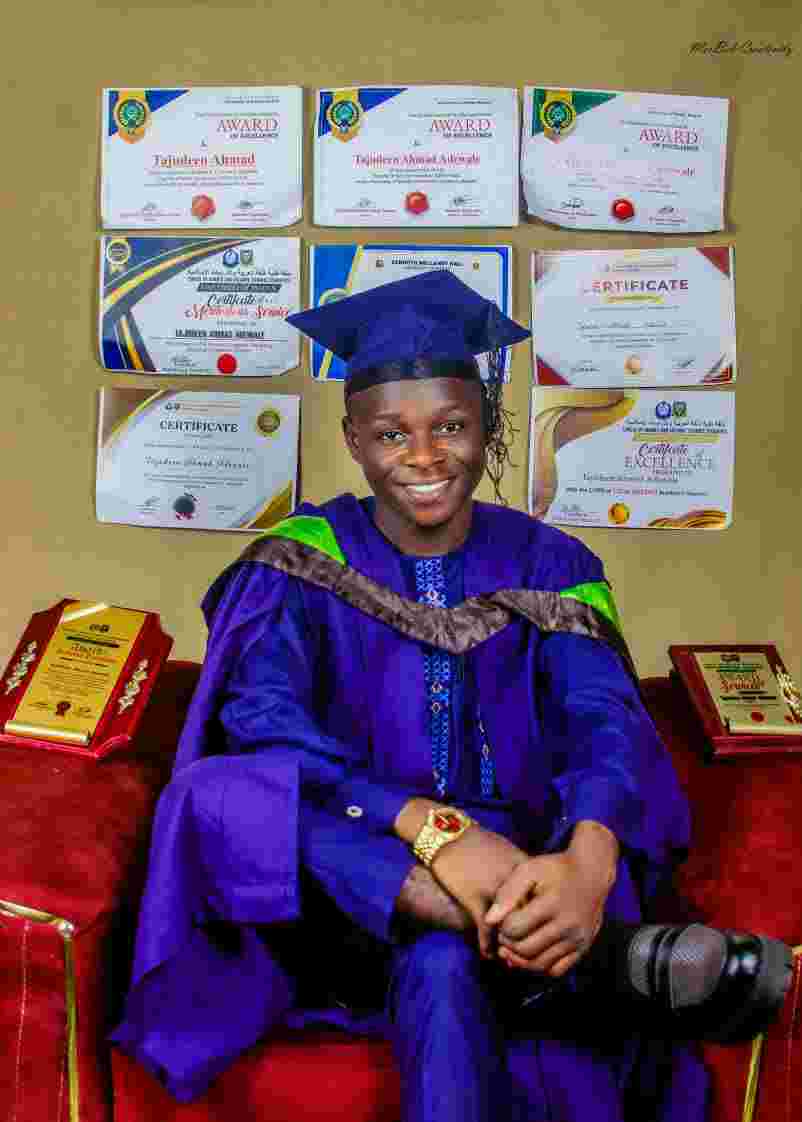
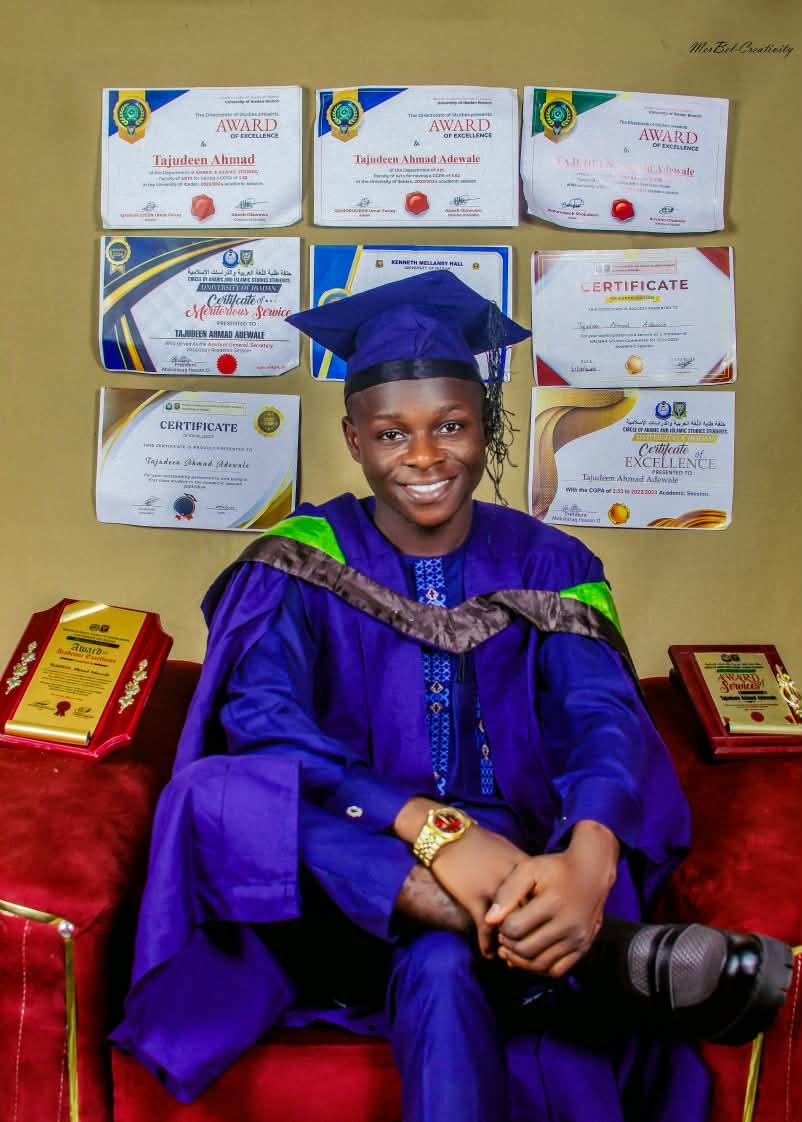
November 12, 2026Ahmad Tajudeen is a First Class graduate of Arabic and Islamic Studies at the University of Ibadan and a former Na’ibul Ameer of the Muslim Students’ Society of Nigeria, University of Ibadan (MSSNUI). Beyond his academic achievement and leadership experience, he also served during his undergraduate years as an Imam and Tutor at the Circle of Learning of Muslim Students' Society of Nigeria, University of Ibadan, experiences that have continued into his work with an online Madrasah. In this interview, he reflects on his time at the University of Ibadan, the demands of leadership, the pursuit of academic and spiritual excellence, and the responsibility of teaching and serving others.
Looking back on your years at the University of Ibadan, what moments or experiences would you describe as the defining points of your undergraduate journey?
When I entered UI, I was full of dreams for my preferred course, Arabic Language and Literature. I wanted to become a certified Arabic scholar, as determined as I could be. However, during our first weeks of resumption at the University, we attended different orientation programmes: the MSSNUI orientation, the Halqah (for the Association of Arabic and Islamic Studies Students), the University of Ibadan’s orientation, the faculty orientation and the UISU orientation. I learnt many lessons at these programmes.
At MSSNUI, I learnt the importance of Islamic brotherhood on campus, fostering spiritual and academic growth together with networking among Muslim students. At the departmental Halqah, I was further motivated in my discipline through the fatherly and motherly advice of two professors, a husband and wife: Professor Afis Oladosu and Professor (Mrs) Habibat Oladosu-Uthman. They told us what we needed to do to become excellent Arabists or Islamists from the Premier University, which is to excel both in courses related to our discipline and in the Western knowledge that contributes to our academic excellence. At the SU and faculty programmes, we were told mainly about the essence of networking, academic excellence and engaging in extracurricular activities.
All the training and enlightenment of those first weeks, through the great men who spoke to us, built me differently in all areas.
You graduated with a First Class in Arabic and Islamic Studies while serving in various leadership capacities. What principles or systems enabled you to maintain excellence without compromising your responsibilities to Allah, your studies and the Ummah?
As for my First Class while combining both Arabic and Islamic Studies, it is nothing but Allah’s grace, and I will forever be grateful to Allah for that. However, it was nothing short of human effort too. It is just that Allah crowned it for me.
At first it was tough. In my 100 level days, I came very close to achieving it but could not, falling short by 0.02. I was shocked, because I had always wanted to see myself as nothing but an excellent student in my field, which Allah later granted me in subsequent levels. I started taking leadership positions from my 100 level days across different segments of the University where I belong: the department, the hall of residence and MSSNUI. All these did not affect my responsibilities; rather, they helped to shape my path.
The main principle that kept me going is “always remember why you started”. While combining everything was tough, remembering that the reason I started the journey was to be excellent fuelled my energy to push harder, no matter the toughness of the hurdles in academics.
As for the religious aspect, Allah used MSSNUI for me. I enjoyed companionship through the Mellanby Hall Ummah (our time-to-time lectures and the togetherness and bond among the brethren in the hall, where we always looked out for one another in both religious and other aspects of life). I also benefited from MSSNUI activities, such as the weekly lectures, as nourishment for the soul, and I met amazing brethren from all angles of the University who were doing well religiously. All these truly helped, because Allah says:
يَا أَيُّهَا الَّذِينَ آمَنُوا اتَّقُوا اللَّهَ وَكُونُوا مَعَ الصَّادِقِينَ
“O you who have believed, fear Allah and be with the righteous.”
So, maintaining focus on the Deen only comes as divine grace and guidance from Allah, and being among the right set of brethren also assisted my growth by Allah’s grace.
Lastly, fulfilling a leadership role in the Ummah is an amānah that we must fulfil once we accept it. The default is that Allah will ask everyone how he or she discharged the duties, and that is why everyone must try his or her best for Allah’s sake. And as the saying goes, in a society rooted in religious teachings, “it’s either you’re there or not”, which means you may not take responsibility conditionally; but if you do, you have to make it count in order to please your Lord and not otherwise.
As a former Na’ibul Ameer of MSSNUI, how has leadership transformed your understanding of service, responsibility and personal growth?
As the position cuts across all areas and units of the University, it helped me a lot to understand what it means to serve the Ummah and to be responsible towards an objective that pleases Allah. As I said earlier, when we entered the University as new students, we saw how our hall Imams, Faculty Coordinators and Excos were putting in efforts to serve Allah through us in all areas of our lives. We enjoyed it and admired it, but we never knew what it meant to take up the tasks. When we were later privileged to be in their shoes, we understood better what the amānah entails.
The position of Na’ibul Ameer shaped my view that positions are not just meant to be name tags, but a responsibility for which Allah could hold everyone accountable. It also assisted my personal growth, because it comes with another level of maturity as you deal with things that you probably would once have thought could never be dealt with. Allah’s guidance and support during this period were ultimately the main guide. The period also provided insights into how to work collectively to achieve certain goals with the other Executive members and my Central Da’wah Committee members (the Hall Imams and the Faculty Coordinators), as a tree truly cannot make a forest.
Lastly, the position shaped the idea that leadership comes with its challenges too, and that you must always prepare for it, as it is not predictable. While the challenges are there, you must learn, pray, consult those who know better about situations, and keep your head high while moving forward and proffering solutions to the challenges.
Having interacted with students from diverse academic, religious and social backgrounds, what realities about university life do you think every Muslim student should understand before stepping onto campus?
One reality we must know about university life is that it is like a world on its own, where people of different types meet. It is a world where living can either make or mar one’s growth, whether spiritually, morally, emotionally, academically, psychologically or in other areas of one’s life.
The earlier a student knows that the decisions he or she makes matter, the better. One must come to the university to mingle with those who are upright in religion, academics and other important areas of life. Indeed, there is a thin line between being responsible and upright and being wayward in the university. For whatever good goal you have or set for yourself, surround yourself with those who can support you. My sincere advice is to always choose a good circle. MSSNUI is a good example of this for all Muslim students.
Many students struggle to maintain consistency in both their academic and spiritual lives. What practical principles helped you remain committed to both throughout your undergraduate years?
The first thing to note is that no one is perfect in these two areas. We are only able to strive in both areas by the grace and mercy of Allah.
In addition, no one can purify himself for people, but we can purify ourselves for Allah and always try to please Him alone.
As for the spiritual aspect, one of the things Allah used to protect us was being in the midst of brethren who were also striving on the path of Allah. One should always endeavour to work on his or her circle of friends and companions. A companion can influence a person’s life and Deen, based on authentic evidence from the Qur’an and the Sunnah of our noble Prophet Muhammad (peace and blessings of Allah be upon him).
This influence can be either positive or negative. Most importantly, MSSNUI served this good-companionship purpose for us. May Allah continue to be with the Ummah (the society and the members, who are the Muslim students). Another important factor is being able to continually attend lectures in various parts of the campus. We had the opportunity to be both the lecturer and the listener. Truly, when you teach or remind others, it helps you grow better too.
As for academics, what helped was surrounding oneself with people of a similar mindset. Whenever we felt tired, we saw them going strong and could tap from their energy. Another factor was staying focused by not underestimating anything given by the lecturers, as nothing that fetches marks can be underrated in UI. This is simply trying one’s best to do the right thing at the right time in all areas of one’s studies.
One important factor in both areas is prayer. It is highly essential.
There is sometimes a misconception that students of Arabic and Islamic Studies have limited career opportunities. From your experience, how would you respond to that perception?
Yes, truly, the misconceptions are there, but that has never been an issue for me. I have always prioritised being an expert in my field, as I combined both Arabic Language and Islamic Studies at the University. One major issue for some students is that they lack awareness and exploration. As for me, I developed an interest in Arabic Language and Islamic Studies from my secondary school days, even when my teachers and those around me would have thought of me going for another course because of the potential they saw in me.
One important thing I did was to research my field. Many would think that if you study Arabic Language and Islamic Studies, you can only be a teacher, mostly teaching in schools and the like, but that is never true. It is just a lack of knowledge about the field. Arabic, for example, offers a variety of career opportunities beyond what some people think. The knowledge itself can be digitalised.
On career opportunities in Arabic: Arabic is not just a religious language; it is a global career advantage.
With Arabic, you can work in diverse and high-paying sectors such as Tech, Business, Embassies and International NGOs, Government, Journalism and Media, Banking and Islamic Finance, Translation and Interpretation, Education, and many more.
The problem is that, without exploring and learning, the average Nigerian is stuck with the popular idea that Arabic is only for Imams and Alfas. In reality, it is a gateway to global opportunities.
In conclusion, in this digital world, everyone needs to learn before forming a notion. Likewise, a person should not just choose a particular field of knowledge without doing research or being clear about what he or she wants to use it for, so as to prevent a waste of time.
Success can sometimes attract recognition and admiration. How have you consciously guarded your sincerity while striving for excellence in different aspects of life?
Allahul-Musta’ān, we are still trying our best, as we are never perfect. However, the only thing I would say here is that one should strive to keep his or her intentions directed towards learning for the sake of Allah. That is part of the struggle for all. One should be intentional about it and also be prayerful.
This question deals with something hidden that we ask Allah to save us from.
University campuses are filled with distractions competing for students’ attention. What personal boundaries or habits helped you stay focused on your long-term goals?
Yes. There are distractions on campus, as people want to mingle and engage, and to do what the masses are doing in order to feel among. One important principle a Muslim needs is that “a Muslim cannot do and undo”, which means that our actions are guided by the commandments of Allah and we should try to follow them even though we have our lapses.
So, amid all these, a Muslim student should try to prioritise things that are beneficial to his or her Deen, learning and life generally. Do not do things because others are doing them; do them because they benefit you by improving you in your religion, studies and life growth generally. Allahul-Musta’ān.
Your commitment to teaching did not end with your undergraduate years; rather, it evolved into an online Madrasah. What inspired that transition, and what gap are you hoping to fill through this initiative?
Well, I have been teaching since I was in the Madrasah. After my graduation from the Madrasah and secondary school, I taught for about seven consecutive years. When I entered the University too, I taught in different schools, both Western schools and Arabic schools (Islamiyyah, as Nigerians say), across my 100, 200 and 300 level days.
These were things I was doing, and the time I spent on them was competing with the time I had for my studies. The teaching drastically reduced during the time I was the Na’ibul Ameer, as it was no longer very feasible to teach physically at places outside the campus. So, at one point, I was introduced to teaching some Nigerians in Switzerland. Their father wanted me to teach them some Islamic sciences courses, and I did that for some time before I could no longer continue, due to some reasons.
I was not able to teach anymore for a while. From the experience of teaching these two students from Switzerland, I thought that I could actually digitalise my knowledge and skill. I then started making YouTube videos on a channel I created during our MSSNUI administration.
I started having international subscribers and audiences from top nations of the world, starting from France and Germany, among others. So one day, a German got my contact information from my YouTube channel and messaged me that he would like to know about my Arabic course package. I had no clue about this because I was not ready. I was shocked, because I had not planned to teach people from abroad or to connect international teaching to my YouTube account, so I could not give him the reply he needed, and that is how the opportunity to teach him was missed. But that is Allah’s ordainment.
So, as we were on the verge of concluding our regime and I was drawing closer to the conclusion of my undergraduate studies, I thought of establishing my institute, and the plan is to make it international, by Allah’s grace, based on my previous international teaching experience and connections. Alhamdulillāh so far. We are committed to digitalising the teaching of both Arabic Language and Islamic sciences, by Allah’s grace.
Has teaching others changed the way you approach your own learning? If so, in what ways?
Yes, it has assisted me in how I learn as well, because learning is a continual process. You know, teaching is always a challenge to do better in your own learning too. There is a saying, translated from the Arabic language, that “he who lacks something cannot give it”. So, teaching and meeting different types of students so far has pushed me to keep going forward, by Allah’s grace. Also, teaching makes a teacher improve in what he teaches, by Allah’s grace.
What has been the most rewarding moment in your journey as a teacher that reminded you why transmitting knowledge is such a noble responsibility?
Allahul-Musta’ān. The rewarding moment? The best of rewards is that of Allah. Two things above others bring about the best feelings for me.
Firstly, the best of people is the one who is beneficial to people. Being able to teach the little we know to people is one of the best things a person can achieve in life when it is mixed with sincerity. May Allah continue to grant us that.
Secondly, teaching knowledge, or being impactful on people through knowledge, is one of the best legacies a person can have in life. It transcends this life: even when a person dies, the rewards reach the deceased so long as people are using the knowledge. We ask Allah to grant us sincerity and acceptance.
From your experience as an Imam, what spiritual struggles do you think are most common among Muslim students today, and how can student leaders better respond to them?
About this, the spiritual struggles I feel students have the most are the following:
1. The urge to feel among: This is when a Muslim student sees other things that people do on campus, most especially things that do not align with the principles of Shari’ah, and if he or she fails to do them with them, they tag him or her an outlier, whereas the standard is upon him or her to ensure that he or she is a paragon for others to emulate in excellence, be it religiously or character-wise. Examples of the things he or she may feel the urge to do on campus are numerous, including intermingling of opposite genders, handshaking, among others.
When a typical Muslim proclaims that he or she does not do so, they see the person as old-school or less exposed to civilisation, whereas it is not civilisation but rather westernisation, as the only true civilisation is the Islamic civilisation, guiding man’s acts based on the commandments of Allah and His Prophet (peace and blessings be upon him).
2. Inferiority complex: Some students feel awful when they are tagged as outliers because they are not doing the indecent things (based on Islamic law) that some other people are doing. This is a recurring issue. They could somehow find it difficult to show their Islam if they continue to devalue their Islamic values in order to please people. May Allah protect us all from that.
3. Inability to navigate a religious challenge: In the same vein, students should not be ignorant about the concept of religious tolerance. Always be good to both Muslims and non-Muslims, but set a boundary for your religion. Let your principle always be “your religion is yours while my religion is mine”, in a pleasant manner. A Muslim does not practise all religions out of wrongly showcasing religious tolerance.
The envisaged solutions are: jihād al-nafs (fighting one’s soul in order to be better), surrounding oneself with religiously upright Muslim brothers and sisters, and learning more about the Deen by attending classes and lectures or by asking important questions of those who know better.
Finally, for students who aspire to excel academically, spiritually and in leadership, what enduring principles would you encourage them to embrace?
To excel spiritually, let the love of Allah be greater in your heart than any other love. This means making gaining His pleasure the ultimate goal. When this is established, other necessary things will become easy by Allah’s grace.
To excel academically, a Muslim student should know that Allah rewards efforts, and should always remember the hadith of the Prophet (peace and blessings of Allah be upon him) which says:
إِنَّ اللَّهَ يُحِبُّ إِذَا عَمِلَ أَحَدُكُمْ عَمَلًا أَنْ يُتْقِنَهُ
Meaning: “Indeed, Allah loves that when any of you undertakes a task, he does it with excellence.”
So, whatever is worth doing at all is worth doing well.
To excel as a leader, Allahul-Musta’ān, nobody can claim that he or she excels, but efforts are clear to Allah, and lead people.The most important factor is to always have a good intention to serve for the sake of Allah. It is easier said than done (except that Allah makes it easy by His mercy).
Therefore, one should fight his or her soul to remain sincere and be prayerful always, so that everything will not go in vain. Another crucial point is that a leader should always remember that responsibility is an amānah that Allah will ask him or her about. So, while these two factors are there, by Allah’s mercy, a person will find Allah’s guidance, aid and mercy for the leadership position in this life and the hereafter.