

Reading time:6 min read
Lessons from Eid al-Adha: On Sacrifice, Compassion, and the Sanctity of Life
Adh-Dhikr Press Editorial Board
June 07, 2026Every year, Muslims across the globe observe Eid al-Adha on the same day, engaging in acts of worship, sacrifice, and remembrance. For people on Hajj, the observance is absolutely uniform; all of them, no matter the age, the power, the wealth, the levels of exposure, the influence and affluence, and any other thing that can be used to classify, stand together in the Kingdom of Saudi Arabia as one. While the celebration across the globe is always marked with pomp and pageantry, it should also often prompt reflection, chief among them, whether we truly understand the lessons behind the festival, or whether we reduce it to animal slaughter, fine clothes, and festive meals.
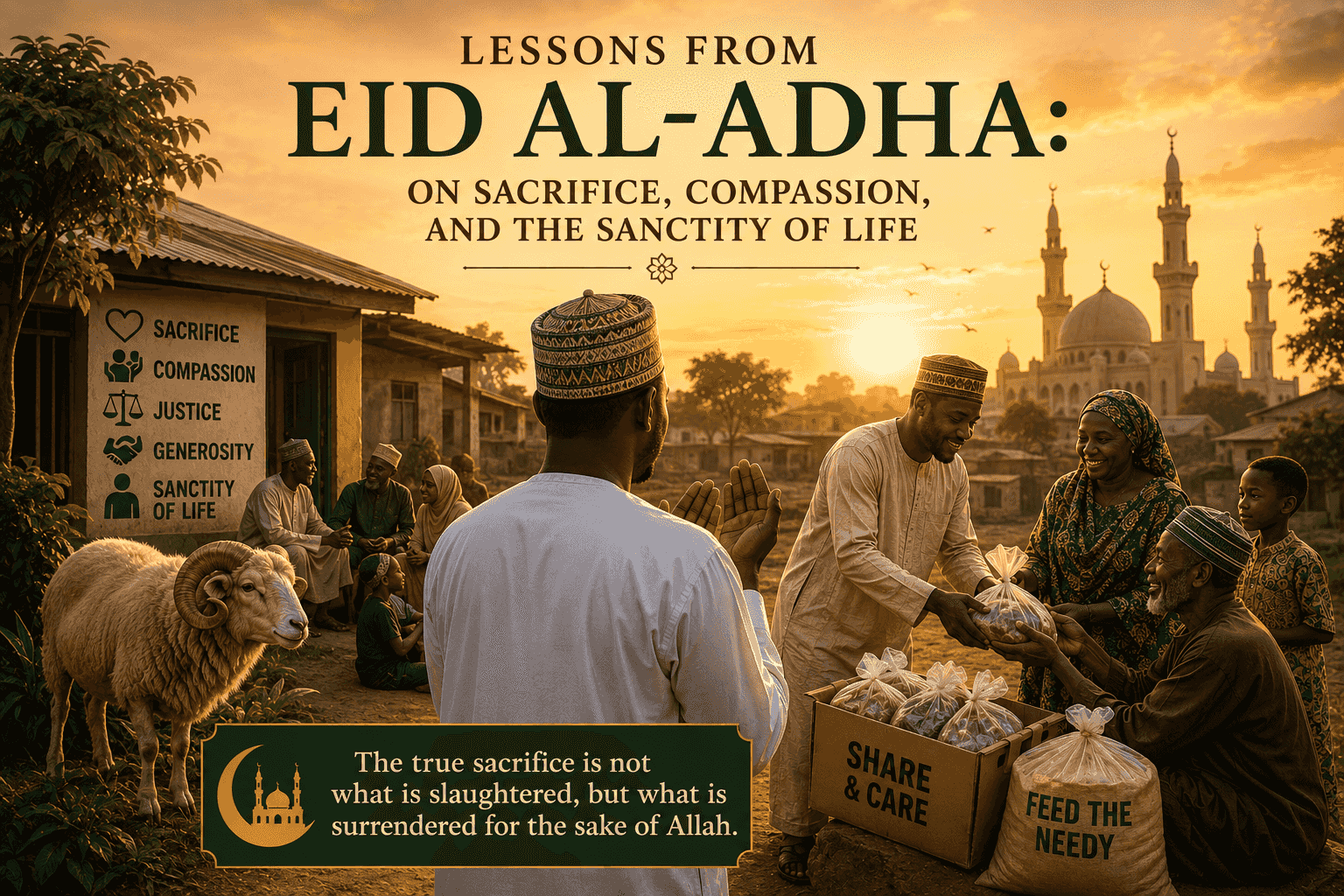
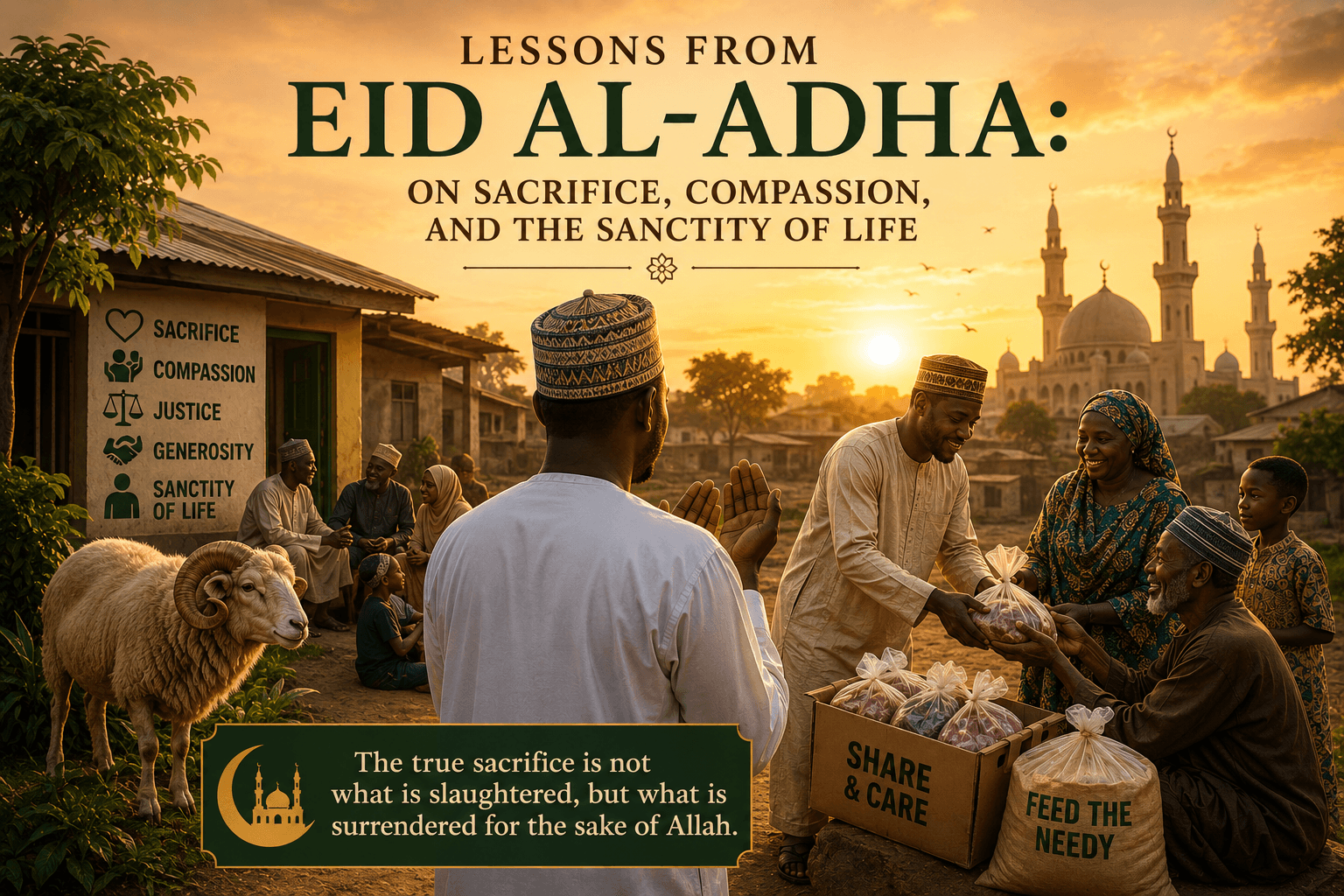
The recently concluded Eid al-Adha came bearing lessons far deeper than the rituals that mark it. It came to teach the values of sacrifice, compassion, obedience to Allah, and respect for the sanctity of human life. The true spirit of Eid al-Adha is lost when the festival is reduced to slaughtering animals, wearing new clothes, and sharing meals. Every Eid seeks to instil values capable of guiding Muslims long after the festivities have ended.
Eid al-Adha traces back to the moment Allah tested Prophet Ibrahim (AS) by commanding him to sacrifice his son, Prophet Ismail (AS). That trial, which Allah made very easy for him, was never about the act of slaughter itself alone; it connoted Prophet Ibrahim's total submission to the will of Allah and his willingness to give up what was most dear to him.
Today, Muslims are not called upon to sacrifice their children, but they are called upon to sacrifice their selfish desires, greed, hatred, and wrongdoing, to let go of ego and personal comfort in service to Allah and humanity, to protect the dignity of the human race and the environment, and to care for themselves as well as for others. The Prophet (SAW) reminded us of this social responsibility when he said: "He is not a believer whose stomach is filled while his neighbour goes hungry." The true act of sacrifice, therefore, is reflected in our character and conduct long after the Eid celebrations have ended.
Even in the act of slaughtering animals, Islam establishes a standard of compassion. The knife must be well-sharpened beforehand, and not in the presence of the animal, so that the slaughter is swift and unhindered. The animal must not be subjected to unnecessary pain; one cannot, for instance, simply set fire to an animal in place of proper slaughter. No animal should witness the slaughter of another. Islam did not leave these matters to chance or personal discretion. They are clear directives, and they reveal how seriously the faith takes the welfare of living creatures, even those whose lives may lawfully be taken.
If Islam commands such mercy towards animals, then human life commands even greater protection. Islam is a religion of peace, and it expressly forbids the killing of innocent souls. The bombing of civilian populations and mob action against innocent people are unacceptable, not merely by the standards of civil society, but by the clear teachings of Islam. Allah says in Surah An-Nisa (4:93) that whoever kills a believer intentionally shall find his recompense in Hell, with the anger and curse of Allah upon him and a great punishment prepared for him. In Surah Al-Ma'idah (5:32), Allah further declares that whoever kills a soul unjustly, it is as though he has killed all of mankind, and whoever saves a soul, it is as though he has saved all of mankind. These verses leave no ambiguity about the value Islam places on human life and the gravity of taking it unlawfully.
It is in this light that the killing of Mr. Michael Oyedokun, a Mathematics teacher in Oriire Local Government, Oyo State, must be condemned in the strongest terms. A man who dedicated his life to educating the next generation was robbed of it in an act of brutality, leaving behind a community in grief and a country that must honestly ask itself how it got here. Such an act stands in direct contradiction to every value that Eid al-Adha seeks to revive. No grievance, real or imagined, justifies the unlawful taking of a life or mob action. Human dignity and the sanctity of life are fundamental Islamic principles, and a society that abandons justice, compassion, and due process contradicts the very essence of what this season teaches.
It must also be stated plainly: those who commit such acts of violence while claiming an Islamic identity are not representatives of this religion. They are enemies of Islam, disloyalists to its principles, and carriers of the very vices the faith forbids. Islam forbids them, forbids what they do, and any attempt to implicate the religion in their crimes must be firmly rejected.
Eid al-Adha is equally a reminder to look beyond ourselves. The feast that marks the celebration is not merely an occasion for personal enjoyment; it is a call to feed the poor, remember struggling neighbours and families, and strengthen the bonds of community. Generosity during Eid should not be performative, dispensed only where it will be seen, but sincere, reaching those who are most in need and least able to ask. Eid loses its meaning when celebration exists without empathy, and when the spirit of giving is confined to those already comfortable.
The lessons of Eid al-Adha do not expire with the festival. Let us sacrifice our vices as we sacrificed our rams, feed our neighbours as we feasted with our families, and uphold justice as firmly as we upheld the sunnah of Ibrahim. For what is Eid al-Adha worth, if the ram is slaughtered and the clothes are worn, but the values die with the celebration?